Blog · May 27, 2026
Introducing Wave Collider
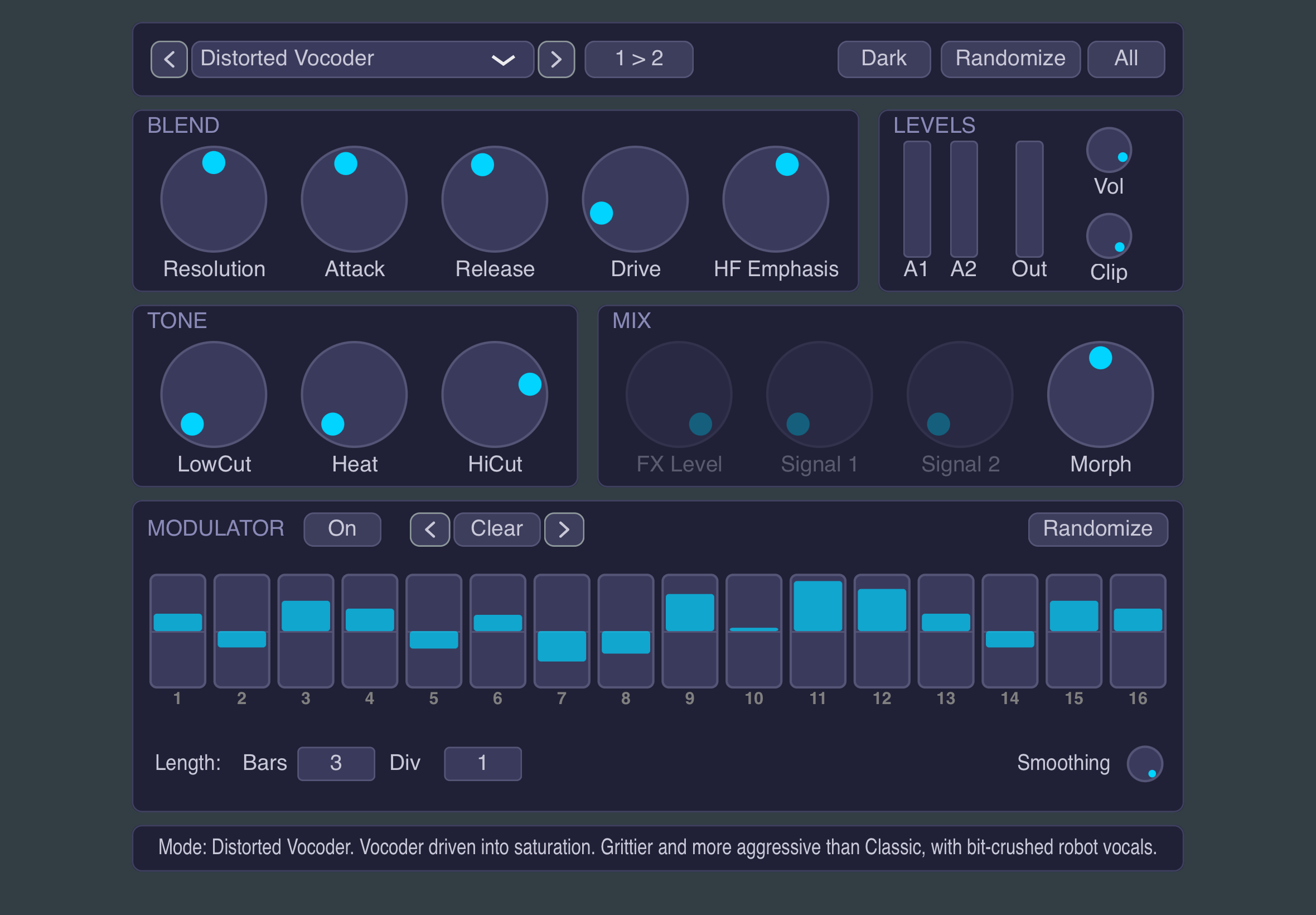
Wave Collider, our new Snorkel Audio plugin, is out! It's an audio effect that takes two audio signals and blends them together through one of 22 modes, ranging from classic vocoders and ring modulation to spectral splicing, probabilistic gating, and scrub-style time-mangling. Drop in two sounds and explore the space between them.
Here's a recent walkthrough from Jade Starr:
Big thanks to Jade for the generous walkthrough.
22 modes, five families
Wave Collider has two audio inputs and one output. Pick a blend mode, dial in the parameters, and the plugin produces something new from the combination. Some modes are recognisable: Classic Vocoder, Ring Mod, Amplitude Follow, Sidechain Duck. Some are less so. Bin Interleave swaps FFT bins between the two signals. Phase Swap takes magnitudes from one and phases from the other. Scrub treats one signal as a position controller for the other.
All 22 modes are grouped into five families: Spectral, Modulation, Dynamics, Stochastic & Time, and Math. Each mode has its own dials, designed to push the sound somewhere surprising while still leaving a useful musical zone in the middle of each range. The same plugin that makes brutal ring-mod overtones makes a vocoded pad two dials later.
A 16-step modulator
Running alongside the blend modes is a 16-step modulator synced to the host transport, sweeping parameters in time with your project. Length and division controls dial in anything from gentle drift to rapid stutter, and the modulator generates musically convincing sequences quickly so you can tweak from a real starting point rather than a blank slate.
The Morph macro
A single dial crossfades between Audio 1, the FX result, and Audio 2. It's the dial that turns Wave Collider from an effect you set and forget into one you can perform with: smooth transitions, automation curves, live gestures that go from dry source to twisted blend to second source in one continuous move.
Three randomize buttons
We learned with Snorkel that randomization, done carefully, is a faster route to interesting results than turning every dial yourself. Wave Collider has three buttons for it: one for the current mode's dials, one for the modulator pattern, and one for the entire patch. Every randomized parameter remains fully editable, so you can keep what works and tweak the rest.
Where to get it
Wave Collider runs as VST3 and AU on macOS and VST3 on Windows. The full feature breakdown and the complete reference manual live on the Wave Collider page.
Wave Collider is also available for iPad on the App Store.