Blog · May 3, 2026
Rethinking the Arpeggiator
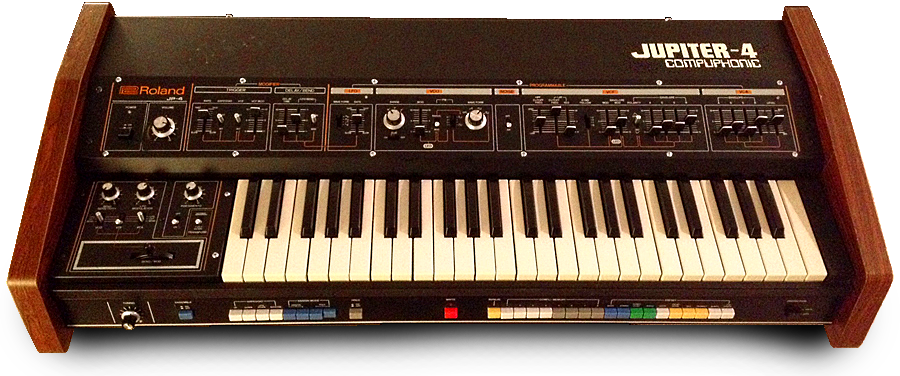
The arpeggiator is one of the oldest tricks in electronic music. The Roland Jupiter-4, pictured above, came out in 1978 with four play modes built into its front panel: Up, Down, Up-Down, Random. Many arpeggiators today still don't offer much more. So here's the question worth asking: why is something this old still so useful, and what happens when you actually push it forward?
This post is partly an appreciation of a feature that refuses to age, and partly an exploration of what can be done differently in 2026 to push this old concept somewhere new.
A short history
Hardware arpeggiators showed up in the late 1970s and early 1980s on instruments like the Roland Jupiter-4, the Oberheim OB-Xa, and the Korg PolySix. On polyphonic synths they were a rhythmic and compositional tool from day one. On monosynths they were something else entirely: a way to fake polyphony from a single voice. Hold three notes on a Roland SH-101 with the arp running and the illusion is convincing enough that whole genres were built on it.
What started as a clever feature in a few flagship instruments quickly became expected. By the mid 1980s nearly every keyboard synth had one. By the 1990s every software synth had one. The arpeggiator survived analog, digital, romplers, the rise of the DAW, and the move to plugins, mostly unchanged. Up, Down, Up-Down, Random.
What an arpeggiator actually does
If you've never used one, the idea is simple. You hold a chord on your keyboard. Instead of all the notes sounding at once, the arpeggiator plays them one at a time, in time with your project's tempo, following whatever pattern you've selected. Hold three keys, get an eighth-note triplet riff. Hold four, get a bar-long melodic phrase. Let go, it stops.
That's the whole mechanic. Hold a chord, get a pattern.
Why producers reach for them
Arpeggiators are useful for the same reason chord stamps and step sequencers are useful: they take an idea you can hold under one hand and turn it into something that moves through time. They reward simple input with rhythmic, evolving output, which is exactly what most electronic music needs.
You hear them everywhere. Trance and progressive house lean on bright, fast 16th-note arps for the signature "running" sound. Techno producers use slower, gated arps as hypnotic background motion. Synthwave and italo disco would not exist without them. Ambient producers use long, slow arps to generate drift. Modern pop uses them as a substitute for human-played riffs because they sit so cleanly in the mix. They pair beautifully with sidechain compression, with delays, and with reverbs that respond to onset.
The arpeggiator survives because it solves a real problem. It turns harmony into rhythm.
Where typical arpeggiators run out of road
Here's the catch. If your arpeggiator only offers Up, Down, Up-Down, and Random, the available variation runs out faster than you'd like. Worse, every other producer using the same plugin is working from the same small palette, which is part of why so many tracks end up sounding the same.
Most of the limits come down to the same things: a fixed gate length, a single pattern at a time, and no built-in way to vary things across a song. The core idea is brilliant, but the standard implementation hasn't evolved much since the late 1970s.
So when we sat down to build Snorkel's arpeggiator, we asked ourselves a question: what would we want from this feature if no one had ever shipped one before?
Snorkel's reframe: a programmable note engine
The first decision was to stop thinking of the arpeggiator as a cycler. The held chord is raw material. Everything else, the rhythm, the contour, the voicing, the variation across a track, should be something you can shape directly, or something you can ask the plugin to shape for you. That reframing changed every design choice that followed.
Here's what came out of it.
A 16 step gate pattern grid
The biggest change is that Snorkel's arpeggiator has a programmable rhythm grid rather than a fixed pattern. Sixteen steps, four rows per step. Each row is a different kind of trigger: anchor on the root, follow the selected arp mode, trigger the full chord, or play a specific chord note. Steps with nothing active stay silent.
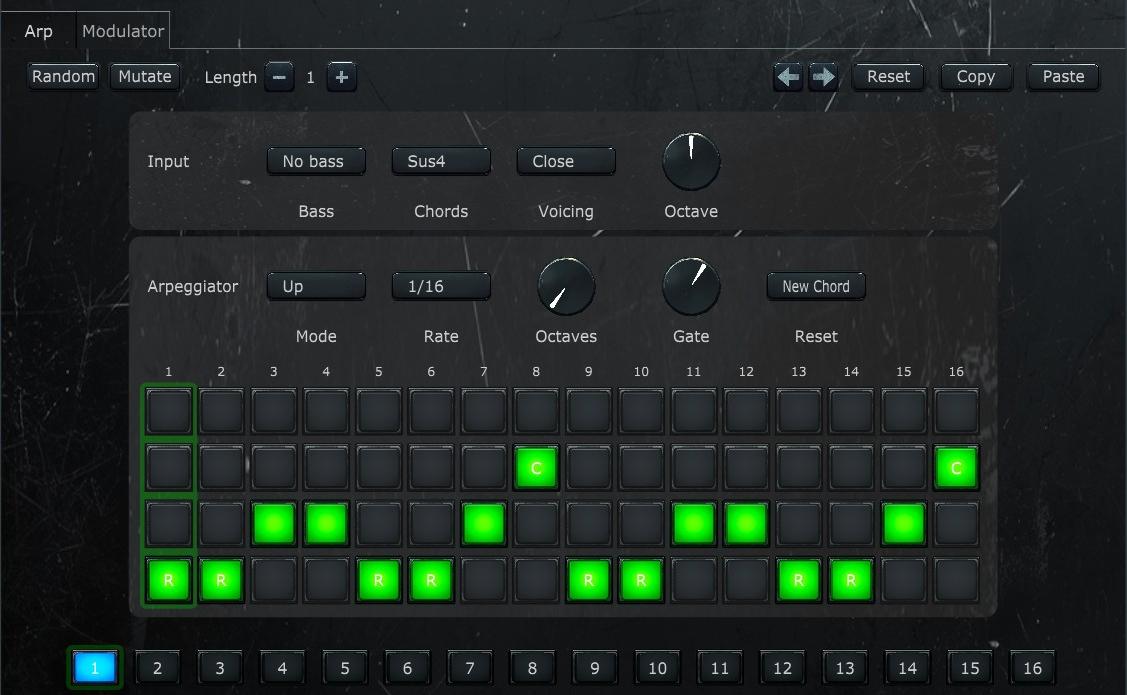
The musical consequence is that syncopation, stutters, complex rhythms, and melodic hooks now can all live inside the arpeggiator. You don't have to render the arp to MIDI and edit it in your DAW to get a non-trivial pattern. You build the pattern where you build the arp.
A real chord engine, with 16 different play modes
Most arpeggiators leave the chord question entirely to you: hold the keys, that's what gets cycled. Snorkel goes a step further. You can feed the arp from built-in chord types (triads, sevenths, sus chords, ninths, elevenths) or from MIDI coming in from your DAW. Voicings (Close, Open, Drop, Wide, Auto) shape how those notes spread across octaves. You can add bass notes below the chord, lock a pedal bass to the root, or strip the whole thing down to a single note and let the arp ornament it. The chord becomes a parameter you can shape, not just a thing you play.
Then there are the play modes. Snorkel ships sixteen of them (Up, Down, Up-Down, Down-Up, Converge, Diverge, Thirds, Skip, Pedal, Thumb, Spiral, Add One, Double, Stutter, Random, As Played) instead of the usual four, each producing a different melodic contour from the same chord input. The same three keys give you sixteen different ideas.
The chord is the input. The arp is what turns it into movement.
Randomization that's actually musical
The randomize button is where the arp stops being a tool and starts being a collaborator. Hit it, and the whole configuration is regenerated: mode, gate pattern, voicing, rate, octave range, the lot.
Getting this right took more time and care than almost any other part of the arpeggiator. True randomness produces noise, and noise is not what you want when you're trying to write a track. What we were after was randomness that's musically meaningful and genuinely surprising, the kind of result that makes you stop and reach for the save button. The engine is tuned with that goal in mind, so most rolls land somewhere between "interesting" and "I would not have written this myself, but I want to keep it".
Here's a quick demo of the randomize button in action, hitting it a few times to show the range of results it produces:
Every randomized parameter stays fully editable. Keep the gate pattern, throw away the mode, adjust the rate. It's the fastest way we know to get unstuck and find arpeggio ideas you wouldn't have arrived at by hand.
Scenes turn an arp into an arrangement
The last piece is scenes. Snorkel's arpeggiator has sixteen of them, and each one stores its own chord, mode, rate, gate length, octave range, and gate pattern, completely independent from every other scene.
The interesting use isn't always the loud, obvious one. It's the subtle one. Loop four scenes across four bars, and in each bar nudge things slightly: a triad in the first, a sus chord in the second, back to a triad in the third, a seventh in the fourth. Or keep the chord identical and just extend the octave range by one. Or leave everything else alone and toggle a single cell on the gate grid for a bit of rhythmic variation. The arp keeps running, but it never quite repeats itself. That kind of evolving variation is something a traditional arpeggiator simply can't produce, and in practice it can be extremely powerful.
Why it still matters
The arpeggiator is a very old trick: hold harmony, get motion. The concept is far from exhausted, but almost no one has tried to push it past the 1978 default.
We did. The result is something we use on nearly every patch we make, and it keeps surprising us. If you want to hear it, the demo is free, and the dedicated arpeggiator page has the full feature breakdown.